

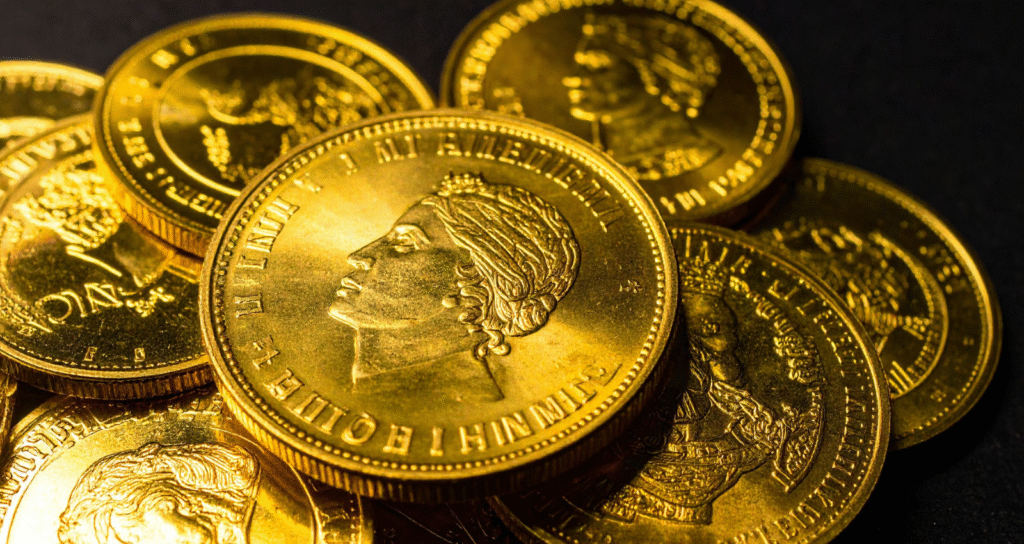
Many of us are familiar with gold bullion coins. Whether you’re looking to diversify your portfolio or own a rare, historically significant piece, they hold intrinsic value that has stood the test of time.
But have you ever wondered how gold coins are made? The process, known as minting, is complex and requires time-honed skills and knowledge to craft each coin. In this article, we’ll walk you through the materials used, explore the history of gold coin production, and explain the step-by-step minting process.
By the end, you’ll gain a deeper appreciation for the quality, care, and expertise that go into creating these small, round, shining treasures.
What are gold coins made of?
While you might think the answer is gold, the exact composition of a bullion coin varies depending on its type and when it was minted. The majority of modern coins, such as the Canadian Maple Leaf and the UK’s Britannia, are struck from pure 24-carat gold (99.99%).
However, the Sovereign or South African Krugerrand are minted in 22-carat gold with a fineness of 91.67%. The remaining 8.33% is usually copper, zinc, or silver, which makes these alloyed coins more durable and resistant to wear. In contrast, pure gold coins are softer and malleable, meaning they are prone to scratches and damage if handled frequently.
The history of gold coin minting
Before we dive into the modern minting process, it helps to understand the long and fascinating history of how humans transformed raw gold into portable, recognisable forms of wealth — prized not only for their value, but also for artistry and cultural influence.
The Lydians
With a history that stretches back thousands of years, it is believed that the first gold coins were produced in the ancient kingdom of Lydia (now the Western part of modern-day Turkey) around 6000 BC. Initially, these were simple discs made of electum, a natural silver-gold alloy, stamped with animal heads.
The Lydians later developed the ability to refine these metals, leading to the world’s first bimetallic coins. Soon, they became an accepted form of currency. Even the smallest coin held significant value, and were primarily used for larger transactions rather than everyday purchases.
The Romans
The Romans took coin production to a whole new level by introducing more intricate designs depicting gods and goddesses, as well as military victories (e.g., a crocodile to symbolise the annexation of Egypt). This was achieved through striking coins with engraved dies — a practice that laid the foundation for modern coin minting.
Furthermore, the Romans established standardised weights and purities, making trade across their vast empire far easier. Coins weren’t just currency; they were also political tools. Emperors stamped their faces and symbols of power to convey their authority and wealth to the public.
The UK’s British coinage
British coins have always reflected the nation’s culture, monarchy, and identity. The first-ever gold Sovereign coin was struck under King Henry VII in 1489. During the following centuries, the Royal Mint continued to refine coin production techniques, incorporating improved methods for precision, weight, and purity.
By the 19th century, British gold coins were trusted worldwide, with gold Sovereigns and other denominations circulating far beyond the British Isles. The designs also evolved, featuring portraits of reigning monarchs and national emblems. Today, the Royal Mint continues this tradition with the Gold Britannia, introduced in 1987, combining heritage, advanced security features, and high-purity gold.
From mine to mint: The step-by-step process
Before a coin reaches an investor’s collection or vault, it must go through a meticulous process involving multiple stages. By using state-of-the-art technology and traditional craftsmanship, raw gold is shaped into the bright, perfectly formed coins.
1. Mining
The journey of a gold coin begins far underground. Gold is mined deep below the Earth’s surface in areas with rich deposits, including South Africa, Australia and Canada.
Modern mining involves removing ore containing gold from the veins embedded in rocks or recovered from riverbeds and sediments using heavy machinery and advanced geology, while adhering to strict environmental regulations. This is a key factor, especially for UK investors who want assurance that their coins come from conflict-free sources.
When extracted, the raw gold is transported to refining facilities for purification. In short, mining is the first step in transforming a natural resource into a tangible, investment-grade asset.
Read our latest blog post to find out more about the origins of gold.
2. Refinement
Extracted gold is never 99.99% pure, as it contains a mixture of other metals (copper, lead), minerals and other elements. Refining removes impurities from gold to ensure it meets the LMBA’s high-quality standard required for bullion coins.
There are two main methods of refinement. The Miller process uses chlorine gas to react with other base metals, forming chloride compounds that can be skimmed from the surface of molten gold. Alternatively, the Wohlwill refining process involves passing an electric current through the gold to strip away any impurities.
After reaching the desired purity level, the gold is often cast into ingots or bars to make it easier to handle, weigh, and transport.
3. Designing
Before a coin is finally struck, a design must be agreed upon. This stage is especially important for commemorative coins, as developing a new design can take years and is commissioned well in advance of major events or anniversaries, such as the Platinum Jubilee or the 80th anniversary of D-Day.
Talented technical artists and engravers work together to draft up a selection of intricate designs for the coin’s obverse and reverse sides. For UK coins, this often includes historical or mythical figures (e.g., St. George and the Dragon), national symbols, and portraits of monarchs.
Once the final design is chosen, it is sculpted into a 3D clay model several times the coin’s actual size to capture every fine line and texture that gives its unique character.
4. Die making
Next, a plaster cast is taken, which is used to make an epoxy resin mould — a precise replica of the coin’s design. Using an engraver machine, it is then reduced to the actual coin size and used to create a steel ‘master’ die.
The master die is arguably the most critical component in coin minting, as it’s the hardened steel stamp that impresses the design onto the gold. From the master die, ‘hubs’ or relief punches are made to produce dozens of working dies. These are heat-treated to withstand the immense pressures when striking thousands of gold blanks.
Each die is regularly checked for microscopic flaws or scratches; otherwise, any imperfection will be instantly transferred to every coin, affecting its overall finish.
5. Striking the coins
Now that the dies are ready to go, the minting process can finally begin. During this stage, gold is heated in a furnace and then poured into ingots or bars, as mentioned earlier. These are made into long, flat strips of a certain thickness. A machine uses a punch to cut out perfectly round blanks, also called planchets.
The planchets are washed, polished, and fed into the coining press between two engraved dies. Immense pressure is applied, imprinting the design onto both sides of the coin. In the case of bullion coins, these are struck once, whereas proof coins are a lot more intricate and valuable, so they need to be struck multiple times. Overall, the striking process ensures every detail, from inscription to imagery, is perfectly captured.
Once completed, the coins are checked for quality and consistency before moving on to finishing and packaging.
Buy authentic UK gold coins from BullionGaint!
If you’re ready to add high-quality gold coins to your collection or investment portfolio, or even gift a coin to someone at Christmas, explore our wide range of LMBA-approved bullion products.
We stock authentic, investment-grade coins, including Gold Britannias available in a variety of sizes and weights, including smaller 1/10 oz and 1/4 oz coins to larger 1/2 oz and 1 oz coins. For more details, contact us on 0800 433 2424, WhatsApp 07747246247 or send an email to sa***@**********nt.com, and our friendly team will be happy to assist.