
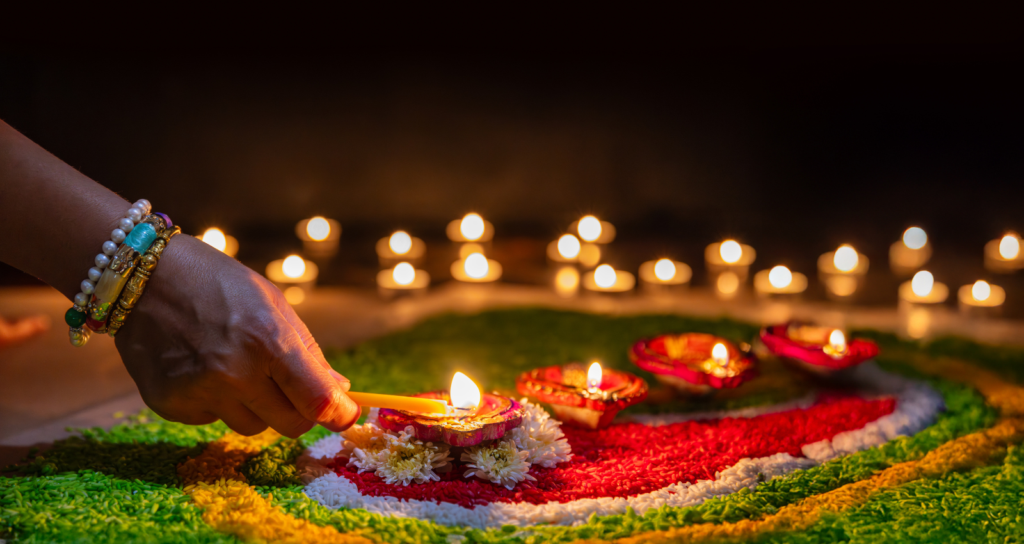
Every year, millions of Hindus, Sikhs, Jains and Buddhists across the world celebrate Diwali, the “Festival of Lights”. While families gather to decorate their homes with colourful rangoli patterns and candle-lit diyas, did you know about the other deep-rooted tradition of gifting gold?
Whether for prosperity, luck, or investment, gold plays a shining role in Diwali festivities. But why? Keep reading to learn more about the fascinating connection between Diwali and gold, and how it continues to hold cultural, historical, and financial significance.
What is Diwali?
Diwali (or Deepavali) is one of the most significant festivals in Indian culture; celebrated between October and November every year. It marks the beginning of a Hindu New Year, symbolising the spiritual victory of light over darkness and good over evil. It also commemorates events like Lord Rama’s return after 14 years of exile, Guru Hargobind’s release from prison, or the spiritual awakening (Nirvana) of Lord Mahavira.
People gather to decorate their homes, shops, and public spaces with oil lamps (diyas) and candles. In fact, the word “Diwali” comes from the Sanskrit deepavali, meaning “rows of lighted lamps”. Sweets (mithai) are also shared between family and friends, and colourful patterns (rangoli) made from rice, powder and flowers are drawn on the floor to welcome guests, while prayers are offered to the goddess Lakshmi for prosperity and happiness in the year ahead.
The 5 days of Diwali
Although some believe it is a single night of fireworks, Diwali is actually a five-day celebration. Each day carries its own meaning and unique traditions, so here is a quick breakdown of the festivities:
Day 1: Dhanteras
The first day is associated with wealth and good fortune, marking the beginning of the festival. People will often clean their homes, buy gold, silver, or new utensils to bring luck into their lives.
Day 2: Naraka Chaturdasi
The second day of Diwali is dedicated to Krishna’s defeat of the wicked demon Narakasura, highlighting that good overcomes evil. Common traditions include Rangoli (colourful floor patterns) and lighting the clay lamps (diyas).
Day 3: Lakshmi Puja (Diwali)
This is by far the most important day of the entire festival, where families wear new clothes, share mithai sweets, and perform evening prayers (Puja) to Goddess Lakshmi and Lord Ganesha for prosperity, followed by fireworks.
Day 4: Govardhan Puja
After the main festivities, the fourth day focuses on gratitude and community, honouring Krishna, who protected the villagers from Indra’s wrath. Many prepare a large amount of food or visit temples as a gesture of thanks.
Day 5: Bhai Dooj
The fifth day is all about the special bond between siblings. Sisters pray for their brothers’ wellbeing and long lives, whereas brothers will give gifts such as sweets, clothing (sarees), jewellery, or cash to their sisters in return.
Diwali and Gold: The Clever Wife and Birth of Lakshmi
We briefly mentioned that gold is exchanged on Dhanteras, the first day of Diwali. Across India and South Asian communities, people buy gold coins, jewellery (necklaces, bangles, earrings), or small gifts such as pendants, believing it will bring blessings and financial security. But the real connection between gold and Diwali lies in two famous Hindu myths.
The Clever Wife
According to legend, King Hima’s 16-year-old son was prophesied to die from a snakebite on the fourth day of his marriage. To save her husband from this fate, the young wife devised a clever plan.
She collected all her gold ornaments, jewellery, and coins, placing them in a heap at the entrance to their bedchambers. To keep her husband awake all night, she also illuminated the chamber with diyas, sang songs and told him endless stories.
When Yama, the God of Death, arrived in the form of a serpent, he was so dazzled and blinded by the gold that he couldn’t enter the room. Captivated by her singing, the god lay on top of the gold pile until dawn and left peacefully.
The Birth of Lakshmi
One of the most famous myths about the goddess Lakshmi comes from the story of the “Churning of the Cosmic Ocean”, also known as the Samudra Manthan.
Long ago, the gods and demons worked together to churn a vast milky ocean in search of divine treasures (Amrit). As the ocean churned, many precious things emerged, including gems, sacred animals, and, eventually, Lakshmi on the night of the new moon in the month of Krtik (Diwali).
When she rose from the ocean, Lakshmi was described as radiant, seated on a lotus flower, with gold coins flowing from her palms, symbolising the wealth and blessings she bestows on the world.
Why do people gift gold during Diwali today?
So, why do people still gift gold during Diwali? For a festival about light, joy, and renewal, gold is both a spiritual, cultural and financial link that brings everyone together. Here are four key reasons why the Diwali gold tradition has endured:
1. Attracting Lakshmi’s blessings
As we know, Lakshmi is strongly connected to Diwali, bringing prosperity into homes that are clean, bright, and welcoming. Gifting gold invites her blessing into the home, believed to encourage not only financial growth but overall happiness. Families will leave gold coins or jewellery near their prayer area during the Lakshmi Puja as offerings to the goddess.
This practice is designed to strengthen spiritual connections and reinforce one’s own gratitude, while expressing hope for continued fortune and luck. Additionally, gold is considered the most “sattvic” (pure) of all metals in Vedic philosophy. Therefore, gifting gold during Diwali is also seen as a way of protection against negative energy (alluding to the clever wife myth). Over time, it has become a spiritual token representing divine favour and blessings that people continue to exchange annually.
2. Investment value
Unlike many modern gifts that may lose their charm or break over time, gold is durable, timeless, and holds intrinsic value. This makes it particularly special during Diwali as a celebration of long-term prosperity. In many cultures, the festival marks the beginning of a new financial year, making gold a beautiful yet smart gift, as its value tends to rise.
This acts as a buffer against inflation or economic instability (e.g., war or currency devaluation). Over the long term, gold has consistently proven to be a reliable asset, which is why purchasing it during Diwali is not just a cultural custom but a prudent financial decision. In a way, it provides both immediate joy while also contributing to the recipient’s future stability.
3. An emotional intergenerational gift
Besides the financial and spiritual aspects, gold is a tangible gift of goodwill that people can treasure for years or even generations. It can be worn, saved, or passed down as a family heirloom, reflecting the festival’s emphasis on lasting fortune. For instance, a gold coin might be given today, but then turned into wedding jewellery years later.
Ultimately, gifting gold is a way to make your presence, love, and respect felt by others, while becoming part of the recipient’s life. What’s more, gold itself is universally accepted, meaning it is suitable for relatives, friends, or colleagues (irrespective of their age or relationship to the giver).
4. Celebrating new beginnings
In some regions, Diwali is considered the start of a new year, and gold symbolises a fresh beginning and new opportunities. Whether it’s a new life, home, business venture, or personal milestone, gifting gold shows your support, enthusiasm and optimism for the future.
Overall, it reminds us that prosperity isn’t just about money but growth and moving forward. Small gifts of gold, such as coins, bracelets, or even small bars, therefore, carry a weight of meaning far greater than their monetary value. They are tokens of wellness, symbolising continued success, whether professional, personal, or spiritual.
Celebrate the Festival of Lights with Diwali Gold from Bullion Giant!
If you’re celebrating the Festival of Lights, we are proud to offer buyers the 5 Gram PAMP Diwali Lakshmi & Rangoli Gold Bar and 5 Gram PAMP Diwali Lakshmi & Peacocks Gold Bar!
Combining religious tradition, elegance, and time-honed craftsmanship, they are perfect gifts for your loved ones this Diwali.
The Lakshmi & Rangoli Gold Bar design depicts the Hindu goddess Lakshmi surrounded by a garland of marigolds and hibiscus flowers, symbols of wealth and cleanliness. On the CertiPAMP™ card, a rangoli of Indian folk art is showcased to denote the happiness, positivity and liveliness of a household.
The Lakshmi & Peacocks Gold Bar features traditional symbols of prosperity, with an ingot design portraying Lakshmi and a CertiPAMP™ card adorned with auspicious peacocks — a revered animal in Indian culture that represents grace, beauty, and immortality.
Plus, with a limited mintage of only 5,000, each bar is accompanied by a vibrant gift sleeve for a truly unforgettable Diwali gold gift. Don’t miss out! Make your celebration shine with a 5g Diwali gold bar available from BullionGiant. For more details, contact us on 0800 433 2424, WhatsApp 07747246247 or send an email to sa***@**********nt.com, and our friendly team will be happy to assist.